
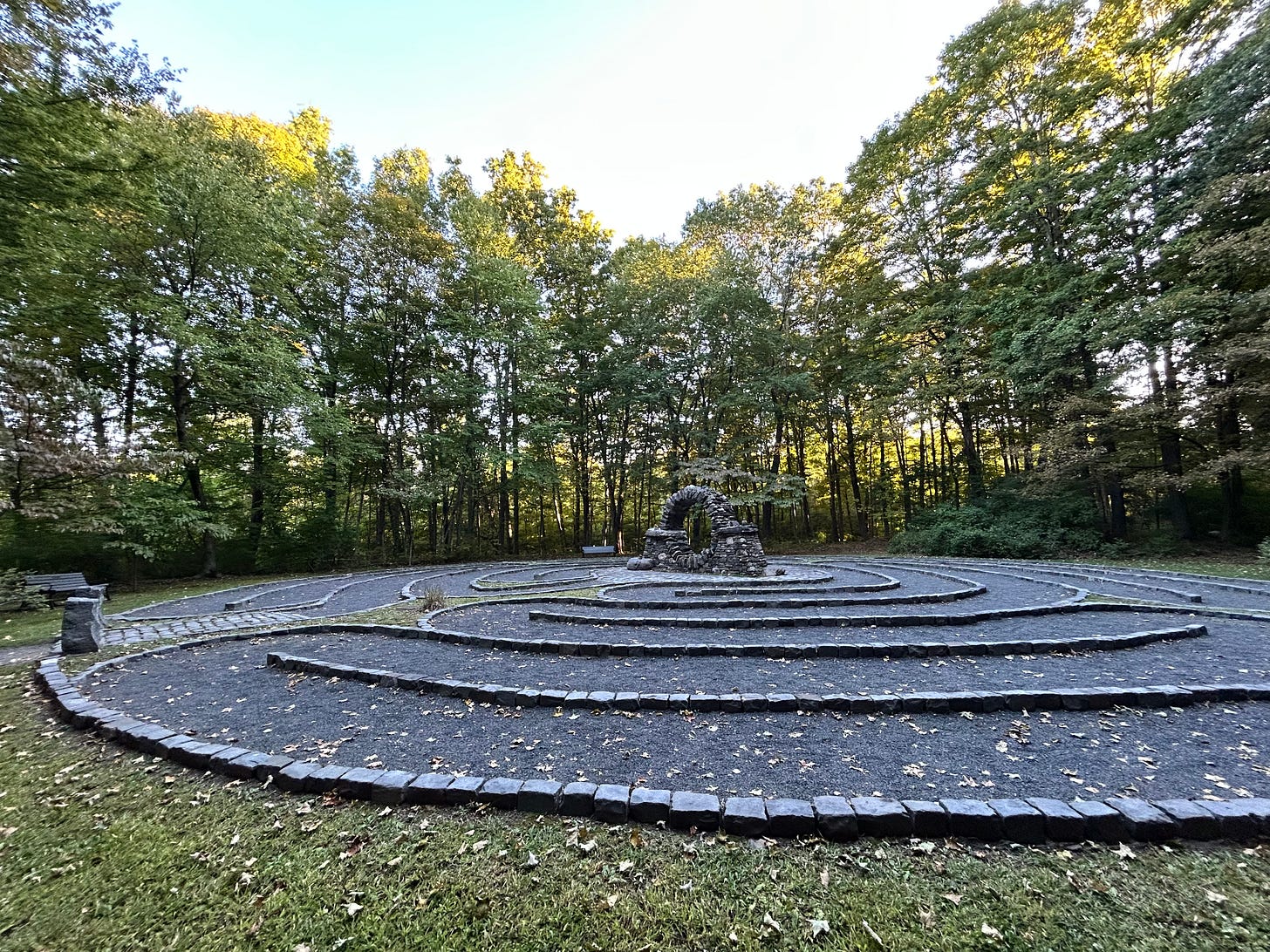
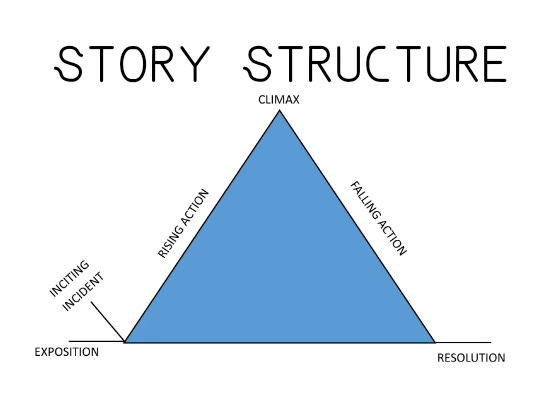
At some point in your early education as a reader you may have had a lesson about the basic structure of a story.
As I searched for an image of the basic structure I was taught (which I just learned is called Freytag’s Pyramid) my third grader looked over my shoulder and excitedly told me she had already learned about it in school.
Overhearing our conversation, my husband yelled “Why are you writing about story structure??” It may or may not have been followed by some fake snoring zzzzzzzzzzzzzzzzzzs…
But it’s a fair question. And I promise there is a reason.
Linear vs. Cyclical Stories
I was listening to the audiobook of Everything is a Story by Kaitlin Curtice on my way into work yesterday, and in it she explains, “Cyclical stories involve elements like seasons, natural cycles, returning to former selves or spaces, while linear stories focus on getting from point A to point B, or finding answers to questions.”1
As opposed to the linear structure more common to European or Western cultures, she explained that her Potawatomi culture is much more rooted in cyclical narratives.
One is rooted in overcoming obstacles, having answers, and forward progress, whereas the other moves slowly, and will cover the same ground more than once.
There seemed to me there was also a contrast of traditionally masculine vs. traditionally feminine energy in these two story types. Not only with the cyclical nature of female biology, but also in the emphasis on presence over perfection, regular rhythms over a singular trajectory, patience over haste.
Dominant cultural concepts of success love a linear narrative. Self-made man. Upwardly mobile. Destined for greatness.
These kinds of stories have their place, but I see the potential for trouble when we feel as though we’re not advancing the way we should be. Most often this sense of advancement is measured by some external standard, but we learn to co-opt it for ourselves. Which is all well and good…until it’s not.
What happens when you’re not advancing? When you find yourself returning to a challenge or a problem you thought you’d already overcome? Does it make you a failure if you’re not always making progress?
But what if—in those times we feel as though we’re failing to make progress along the path we think we’re on—we’re not failing but rather inhabiting the wrong kind of story?
Maybe we’re not making linear progress because this story is cyclical. Maybe there’s not some end goal we should be reaching, but the purpose is the journey itself, round and round and round again.
In a cyclical story, we expect to revisit places we’ve been before, each time with new wisdom and perspective. Ultimately it feels like a spiral, cycling around again, but slightly shifted to a new place.
Spirals and Labyrinths
I’m drawn to the spirals and complex knots found in Celtic imagery and art, and I love to wander the spiral of a labyrinth as it folds back on itself again and again.
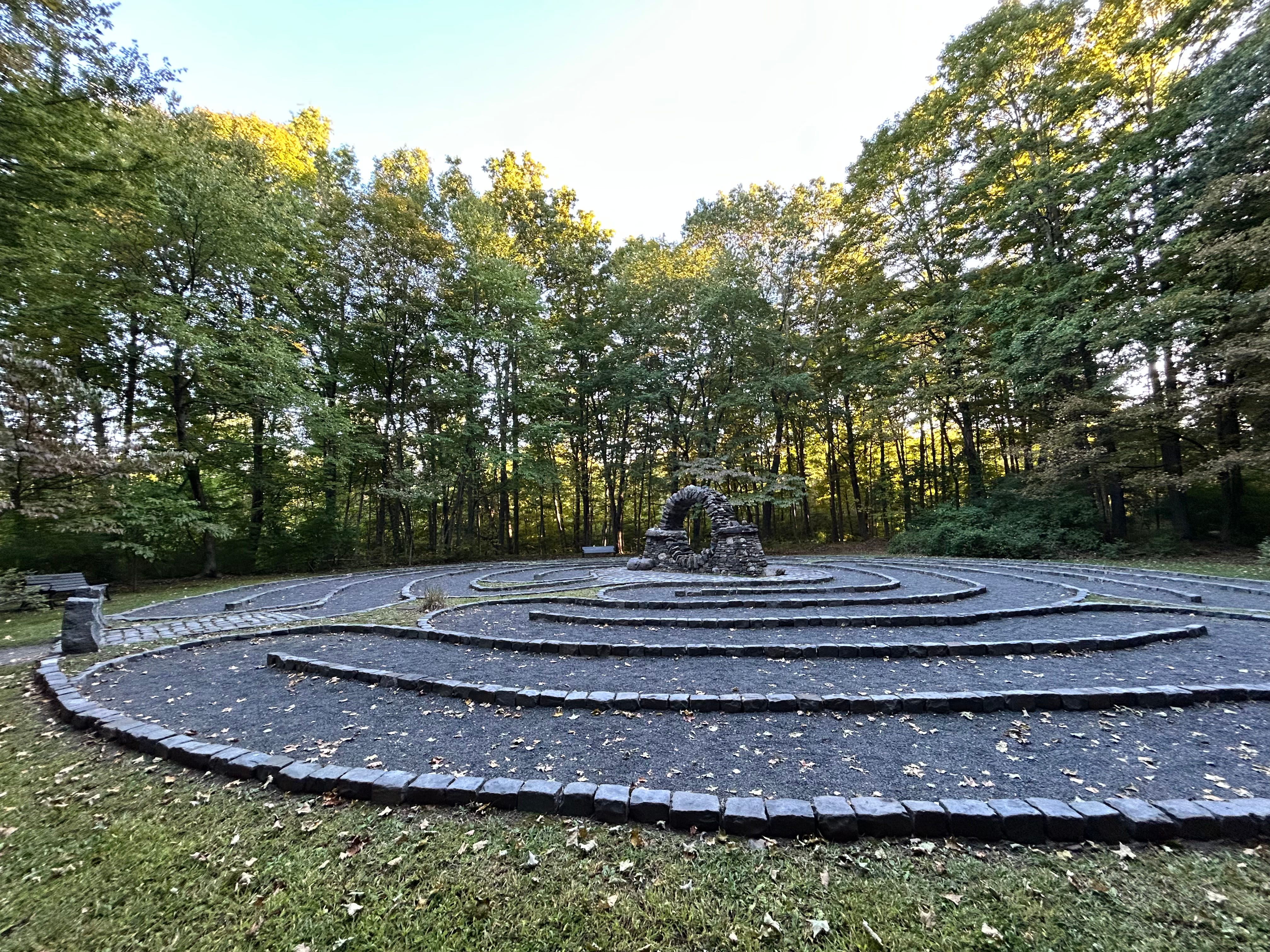
Sure, it’s possible to walk from the entrance of the labyrinth straight to the center. Significantly more efficient than going around and around again. But why bother? Labyrinths aren’t built to get to the center, but for the journey in and the journey out.
When life brings us back to somewhere we’ve been before, it’s not regression but a chance to see the place anew.2
I moved back to the boarding school campus where I’d previously lived, just two houses over from the one I’d left five years before. But my appreciation for the place, its beauty, its community, so much more than it could be if I’d never left.
Maybe it’s not a physical place, but an experience.
I returned to the work of therapy after fifteen years away with much greater clarity about how I’d show up to support others on their journeys, profoundly shaped by all I’d done in years in between.
Or a lesson we needed to learn again.
Fighting to find and believe in myself amid the noise of toxic voices in different seasons of my life, I’ve discovered new strength and gifts I never knew I had.
Switchbacks
In sharing about her experience of walking the turns of a labyrinth folding in on themselves, Kaitlin Curtice likens them to the switchbacks on mountain trails.
She writes, “The point of a switchback is to make a difficult trek easier, especially in a precarious or steep area. As I walked the tiny switchbacks of this Indiana labyrinth, I felt the reality sinking into my bones that every time I climb with my family or practice embodiment, I’m making the healing journey a little more manageable, a little more stable, a little more gentle.”3
There’s a gentleness to a cyclical story that a linear story does not allow. It just takes time sometimes.
Living a Cyclical Story
I’m mindful that we are living in a time when gentleness seems absent, and I wonder about the wisdom of a cyclical story for us today.
If there’s not one linear story that’s headed the right or wrong direction, then we’re also not consigned to one particular outcome. Linear stories might claim there’s only forward and backward, but we’re not on a line. We’re in a spiral.
Even as we face challenges we thought we’d put behind us, we’re not starting over. We have more wisdom than we did before, and we take the experiences we’ve had and the lessons we’ve learned with us as we go. We have deeper understanding, new perspectives. We can make different choices, to allow ourselves to be changed in new ways.
Even if it seems like things in this world are going the wrong direction and all is lost, we do not lose hope.
We’re not turning around, we just have to keep going.
The story’s not over yet.
Charlotte is a therapist and clinical supervisor at Thrive and Grow, as well as an Episcopal priest, a spiritual director, and a mom of three. You can read more of Charlotte’s writing at https://substack.com/@afiercehope
- Everything is a Story, 66. ↩︎
- h/t to TS Eliot for this one:
With the drawing of this Love and the voice of this Calling
We shall not cease from exploration
And the end of all our exploring
Will be to arrive where we started
And know the place for the first time.
(from Little Gidding, the final poem of The Four Quartets) ↩︎ - Everything is a Story, 124. ↩︎
Leave a Reply